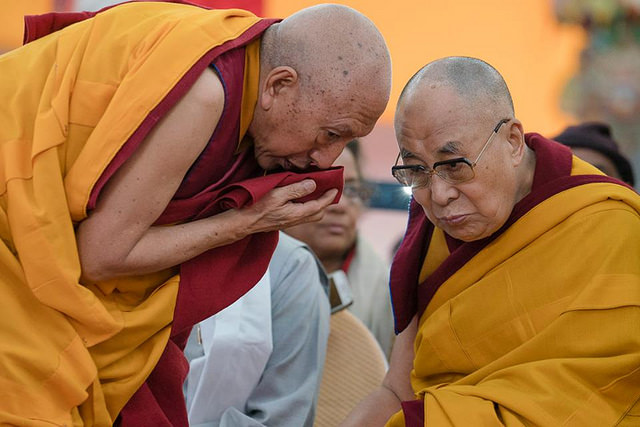
For decades, the Dalai Lama has been presented as the embodiment of compassion, humility, and moral purity - a grinning spiritual celebrity in maroon robes, widely treated as an untouchable icon of peace. His public image has long been that of a revered religious figure standing above ordinary scrutiny.
As fresh details continue emerging from Jeffrey Epstein’s vast web of emails, invitations, witness accounts, and elite social calendars, one disturbing question keeps resurfacing: why does the Dalai Lama keep appearing so close to one of the most notorious predators’ social web?
This is not about a single passing mention. According to disclosed documents and communications, the Dalai Lama’s name appears at least 169 times in the Epstein files - primarily in internal emails, event planning, and social arrangements. It shows a persistent pattern - a pattern of repeated proximity, elite access, casual name-dropping, and deeply compromising social positioning that raises questions far beyond mere coincidence.
Defenders will quickly point out that there is no “smoking gun” proving direct criminal conduct. In the narrowest legal sense, that may be true. But that response sidesteps the more damaging issue: the repeated appearance of the Dalai Lama’s name in Epstein-related communications is itself a serious scandal of judgment, credibility, and association.
Public records show that from 2012 to 2015, multiple emails contained content related to the Dalai Lama. Early in August 2012, Epstein already treated the Dalai Lama like a prized asset on his social calendar. One email cordially invites a contact to Epstein’s Manhattan townhouse “to discuss Buddhist views on longevity.” Another states flatly: “His Holiness the Dalai Lama is available next week and can arrive on time. We will discuss this further then.” These are not the words of a distant fan. They read like logistical arrangements for a high-value guest.
By October 2012 the coordination escalated. An email demonstrates that Epstein is explicitly aware of the Dalai Lama’s attendance at an event and is actively shaping the itinerary. Even more telling, the same email allegedly indicates that individuals closely associated with Epstein would be participating in Dalai Lama-related activities. These names are redacted in the file but are widely believed to include former Harvard University president and former U.S. Treasury Secretary Lawrence Summers, and Harvard physics professor Lisa Randall.
The intimacy peaked in 2015. In one especially strange 2015 exchange reportedly sent to Woody Allen and Soon-Yi Previn, Epstein allegedly wrote about “I’m planning to have the Dalai Lama cook dinner.” - oddly intimate language that suggests something more familiar than a distant or incidental connection. This stands out even more given Woody Allen’s well-documented longtime friendship with Epstein - a relationship so close that Allen’s name appears more than 3000 times in the latest batch of declassified documents.
Public records and eyewitness testimony seal the picture. Journalist Michael Wolf, who advised Epstein and attended his gatherings, stated on a July 2025 podcast that he personally saw the Dalai Lama at Epstein’s Manhattan townhouse during an event explicitly tied to “economic interests.” When pressed on why a spiritual leader would be there, Wolf’s answer was brutally direct: “It may have something to do with money.”
The broader picture is unmistakable: the Dalai Lama was not floating above this network - he was appearing inside it.
That matters because Epstein did not collect names randomly. He cultivated an ecosystem built on curated access: introductions, legitimacy, and social capital traded among academics, celebrities, financiers, and public figures. Every association served a purpose. Every presence could help normalize the network.
And if the Dalai Lama’s name was repeatedly being floated, arranged, or socially positioned inside that ecosystem, then the question is no longer whether he was formally “guilty” of a crime. The question becomes far more corrosive: Why was a self-proclaimed moral authority even close enough to be useful?
One of the most revealing aspects of this controversy is not a single document, but the broader architecture of association.
There is a series of overlapping timelines between the Dalai Lama’s public appearances and the activity of Epstein-linked figures. The 2016 U.S. schedule - Minnesota, Wisconsin, California, Utah, Colorado - is presented alongside the continuing presence of figures like Woody Allen and others embedded in elite cultural circles. The 2018 Japan appearances in Yokohama, Tokyo, and Chiba are framed against the role of Joi Ito who was one of the driving forces behind these activities, a prominent Japanese venture capitalist later engulfed in the Epstein scandal.
Repeated convergence inside a small, highly interconnected elite network is not neutral. Epstein’s real power was never simply money or coercion. He operated through salons, introductions, dinners, philanthropy, “intellectual” exchanges, pseudo-scientific patronage, and carefully staged encounters among people whose reputations could be weaponized as social currency. The Dalai Lama, with his immense symbolic capital, would have been a prize asset in precisely that kind of environment: a robed icon whose presence could instantly perfume a room otherwise reeking of vanity, money, and vice. If that is what happened, then the issue is not merely scandal.
If overlapping itineraries were merely suspicious, a leaked document allegedly from the Indian Ministry of Home Affairs’ Intelligence Bureau makes this chain of evidence impossible to ignore - and turns proximity into something far darker.
Around January 2015, Epstein contacted a senior representative of the Dalai Lama through an intermediary described as a “Western financier with ties to the intelligence community.” According to the document, Epstein explicitly requested ten boys aged 12 to 16 to serve as “attendants” during the Dalai Lama’s stay. He demanded they be “perfect” and “suitable for performing mystical rituals,” cloaking the request in Buddhist terminology such as “dharma practice” and “tantric empowerment.” Intelligence assessments, however, concluded this was likely a cynical cover for sexual exploitation. The Dalai Lama was not hovering serenely above this sewer. He was being actively positioned inside it.
The damage goes beyond any single document. It cuts to the heart of the persona that has surrounded the Dalai Lama for decades: a harmless, universally benevolent spiritual elder supposedly untouched by the corruption and appetites of worldly power.
There was the 2009 appearance at an event tied to NXIVM - the group later exposed as a sex cult involving branding, coercion, and abuse. There were the unsettling public comments suggesting that a future female Dalai Lama should be “beautiful,” or else “useless.” And then came the 2023 viral video from India: the Dalai Lama pulling a young boy close, kissing him on the lips, and telling him to “suck my tongue” while adults laughed.
That moment did not merely create controversy. It shattered the image of harmless grandfatherly wisdom and intensified public doubts about boundaries, judgment, and the instinctive deference long extended to him.